
ENID's Systems Map is a rapid organizational assessment that reveals how people, workflows, technology, and business requirements interact across your organization. By making hidden dependencies, bottlenecks, workarounds, and decision gaps visible, the assessment helps leaders understand where change will have the greatest impact before investing in new technology, restructuring, or process redesign.
Systems Map

How complex is your organization? Find out in less than 5 minutes with our simple, free assessment tool.
What you can see
What you can’t see
WHAT YOU RECEIVE
Operational Systems Map
A single visualization of how your people, processes, and technology currently interact.
You will receive three priority recommendations, each based on Human, Technology, and Business Factors, highlighting where change will have the greatest impact. These are provided in a concise written summary, followed by a discussion to review details and address questions.
HOW WE ASSESS YOUR ORGANIZATION
We combine organizational research, service design, systems thinking, and technology auditing to understand how work actually happens—not simply how processes are documented, including:
High-level operations technology audit
Data audit
Employee shadowing / contextual inquiry
1:1 stakeholder interviews
Employee survey
Workshops mapping current operational processes
Document review — onboarding, support, L&D/training, governance, and cybersecurity protocols
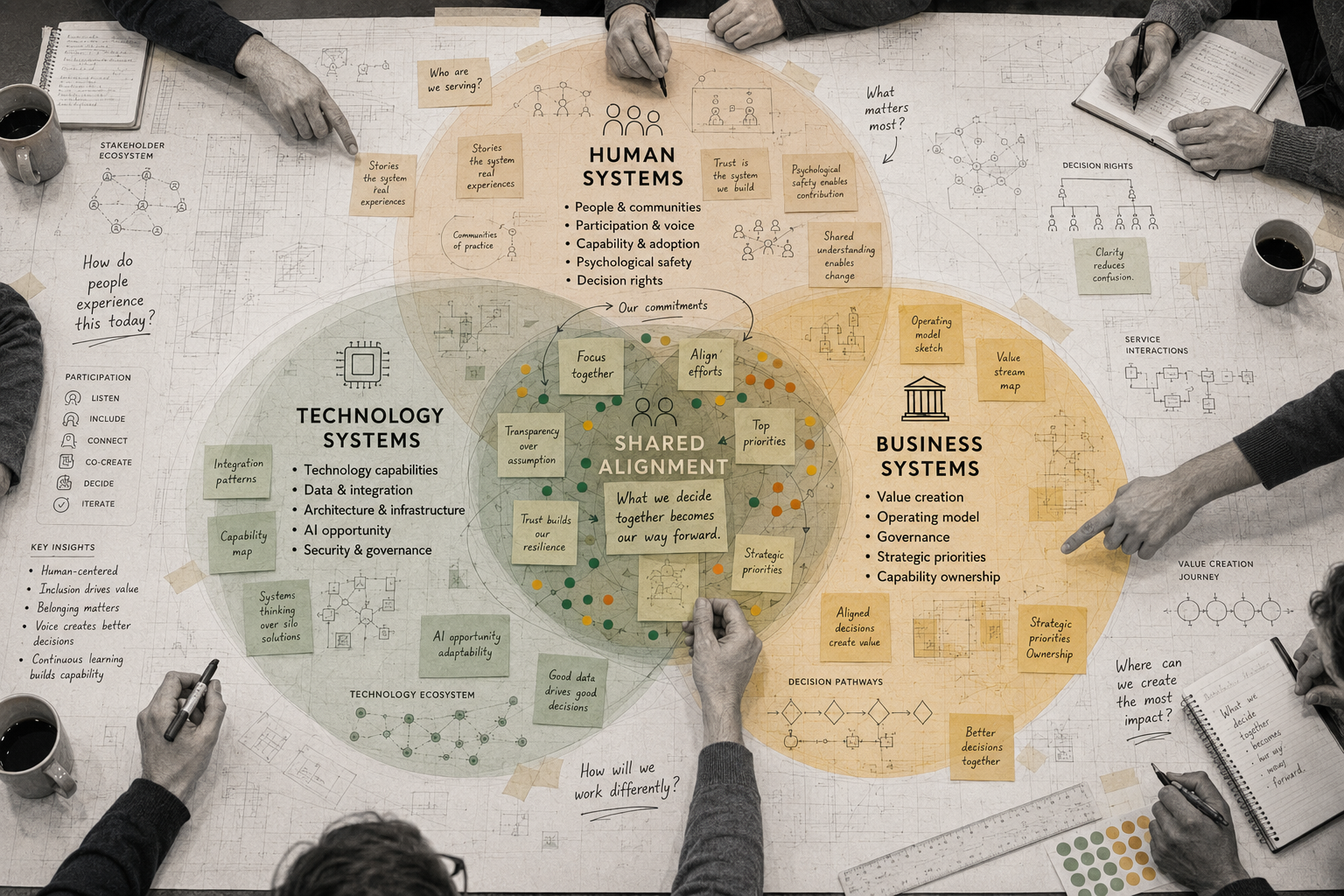
Systems mapping combines organizational research with the lived experience of people doing the work.
See your organization through a different lens.
Every Systems Map examines three interconnected dimensions of organizational performance: Human Factors, Technology Factors, and Business Factors. Looking at them together helps reveal problems that are difficult to see when people, processes, and technology are assessed independently.

-
How do your employees actually experience work?
-
How well does technology support employees’ work?
-
How effectively are you organized to achieve your goals?
Wondering if ENID is right for your organization?
Clients often recognize the symptoms — manual work, communication challenges, technology frustrations, and inconsistent processes, but it's difficult to know whether they're separate issues or connected parts of a larger system.
The system assessment is designed to help you step back, look at your organization as a whole, and identify where greater understanding could create the greatest impact.
The operations map isn't trying to document every process or answer every question.
Instead, we're looking for the signals that matter most.
Together, we identify:
Patterns that repeat across teams
Points where work slows down or becomes more difficult than necessary
Existing strengths that can be expanded
Opportunities for AI and automation grounded in real work
Organizational capabilities that already exist
Areas where deeper investigation is likely to create the greatest value
Cybersecurity risks and data reliability
The goal is to identify the best way to invest your time, energy, and resources where it will have the greatest impact.
Nimble, evidence-based decision-making.
By bringing together evidence from across your organization, leaders and practitioners begin working from a shared understanding rather than competing perspectives or individual opinions.
Maps are completed in 3- 10 days, depending on your organization's size and complexity.
We start with a free conversation — not a proposal
We do not move forward with any scope or proposal until we have discussed your current situation and objectives. If a Systems Map makes sense, the next step is a free stakeholder mapping session. There is no charge or obligation.
We bring together a diverse group of your stakeholders and internal subject matter experts, typically 4 to 8 people plus our team, for an hour. This session helps us understand your work environment and assess alignment for a successful partnership.
You will experience a practical example of our approach before making a commitment.

When is a Systems Map worth the investment?
-
✔ You know something isn't working, but you're not sure why.
✔ Different leaders describe the organization's biggest challenges differently.
✔ Previous improvement efforts haven't produced lasting results.
✔ You're preparing for significant organizational change.
✔ You're considering a major technology investment.
✔ Work depends heavily on tribal knowledge.
✔ Teams have developed different ways of doing the same work.
✔ Leaders want to prioritize where change will have the greatest impact.